
Key takeaways
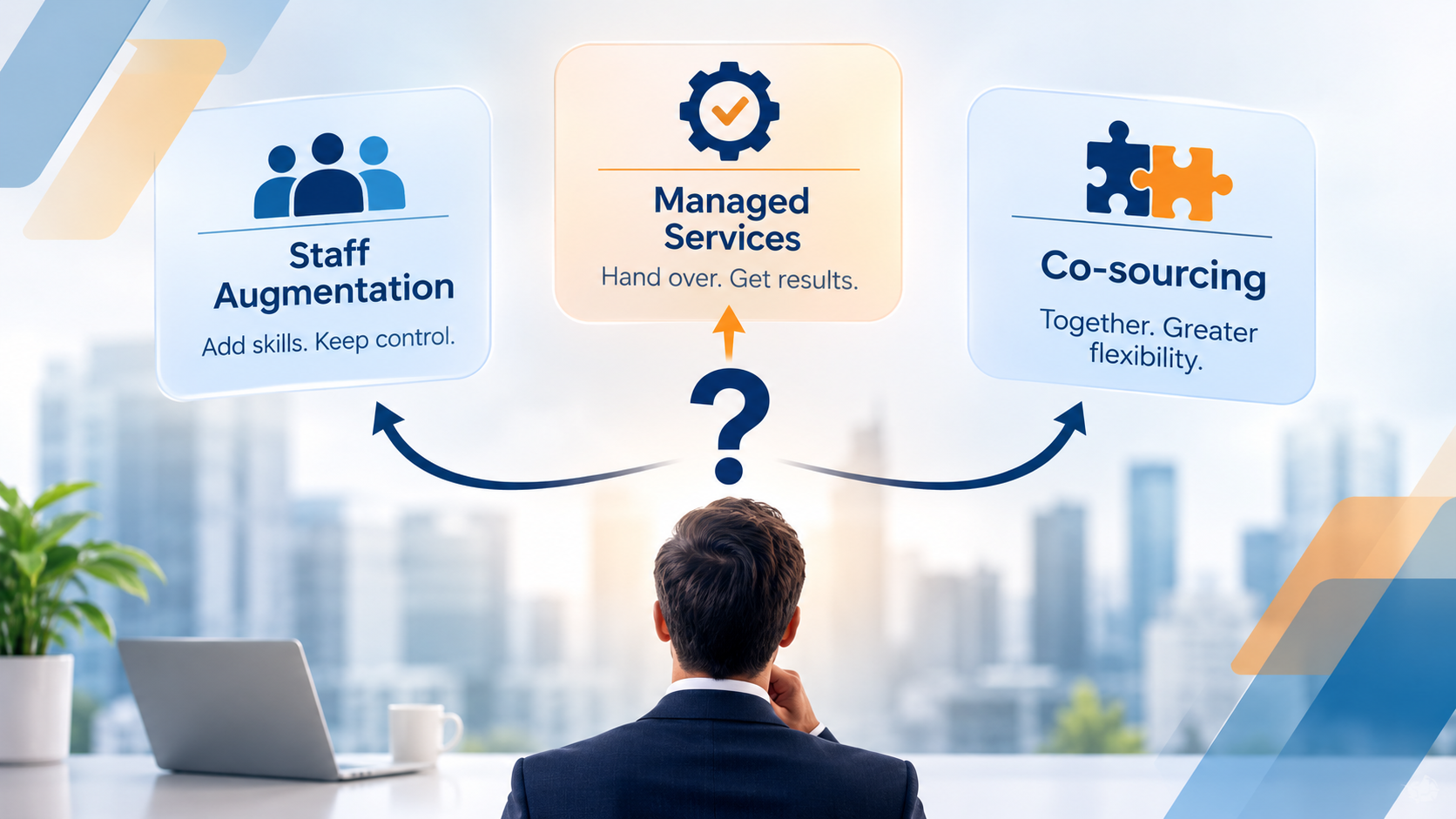
- Staff augmentation adds people to your team; you direct the work and carry the delivery risk.
- Managed services hand a defined service to a provider, who is accountable for the result.
- Co-sourcing blends the two: your team and the provider’s human and digital workers operate as one capability. Under Allied’s FRA™, it removes fixed Labour Liability without handing over control.
When an IT team is stretched, the usual question is “should we bring in contractors or hand this to a provider?” That frames it as a two-way choice: staff augmentation or managed services. Most comparisons online stop there.
But there’s a third model that many organisations end up in anyway, often without naming it: co-sourcing. This guide compares all three, so you can choose based on control, cost and risk rather than habit.
What is IT staff augmentation?
IT staff augmentation is hiring external specialists to work inside your team for a period of time, under your direction. You decide what they work on and how; the supplier provides the people and handles their employment.
It’s a fast way to fill a skills gap or add capacity for a project without permanent hires. But you still manage the work, and you still own the outcome.
What are managed services?
Managed services means handing responsibility for a defined IT service, such as the service desk or infrastructure management, to a provider who runs it against agreed service levels. You specify the result; the provider decides how to deliver it and is accountable when it doesn’t happen.
What is co-sourcing?
Co-sourcing is a shared delivery model where your internal team and a provider’s team work together as one blended capability. You keep ownership of strategy, relationships and the knowledge that’s specific to your business. The provider brings capacity, specialist skills and, increasingly, digital workers that take on routine work.
It’s neither renting people nor handing over a service. It’s designing one team that draws on both.
Staff augmentation vs managed services vs co-sourcing
| Staff augmentation | Managed services | Co-sourcing | |
| What you buy | People’s time | A defined service | A blended capability |
| Who directs the work | You | The provider | Shared, with clear roles |
| Who owns the outcome | You | The provider, against service levels | Shared, with agreed measures |
| Control | High | Lower day to day | High on strategy, shared on delivery |
| Knowledge stays with | Often leaves with the contractor | Mostly the provider | Your organisation, by design |
| How cost behaves | Rises with headcount and hours | Fixed fee or tiered price | Can follow demand (outcome-based under FRA™) |
| Labour Liability | Reduced but still tied to people you direct | Moved to the provider | Minimised: capacity flexes with need |
| Best for | Short-term gaps and projects | Stable, well-defined services | Ongoing work that needs both control and flexibility |
When staff augmentation makes sense
- You need a specific skill quickly, for a defined period.
- You have strong internal management with time to direct extra people.
- The work is a project with a clear end, not an ongoing service.
Watch out for “temporary” contractors who stay for years. At that point you’re paying a premium for permanent capacity, and the knowledge still walks out when they leave.
When managed services make sense
- The service is well understood and can be measured clearly.
- You’d rather specify outcomes than manage people.
- You want predictable costs and someone accountable for service levels.
Watch out for pricing that’s sized to peak demand, so you pay for idle capacity in quiet months. Our guide to managed IT services pricing explains the models and their blind spots.
When co-sourcing makes sense
- You want to keep strategy, relationships and business knowledge in-house.
- Demand varies, and a fixed team is either overloaded or underused.
- A large share of the work is routine and could be handled by digital workers.
- You want to build your own team’s capability, not replace it.
The hidden cost: Labour Liability
The real difference between these models isn’t the day rate. It’s who carries Labour Liability: the cost, risk and rigidity of fixed headcount that stays on the books whether the work is there or not.
Staff augmentation reduces it a little, because contractors are easier to release than employees, but you still pay for every hour you direct. Managed services move it to the provider, who usually builds it back into the price. Co-sourcing, designed well, reduces it by making capacity variable in the first place.
How Allied approaches co-sourcing
Co-sourcing sits at the heart of how Allied works. Under our Flexible Resource Architecture (FRA™), your team and ours operate as one, with three layers behind it:
- A shared specialist pool that scales with demand, rather than a fixed team sized to peak.
- Digital workers that resolve routine work end to end through FusionWork™. In our service desk operations, that’s 84%+ of incidents with no human involvement (Allied’s stated figure).
- A Variable Capacity Workforce that reconfigures as your needs change, so you’re not paying for capacity you don’t use.
Because Allied operates under DHRA™ (Digital Human Resource Architecture), with its no-layoffs commitment, co-sourcing is about adding capability to your team, not taking jobs from it.
Need senior leadership as well as delivery capacity? Fractional leadership follows the same logic: senior capability when you need it, without a permanent hire.
Questions to ask before you choose
- Do we need extra hands, a delivered service, or a blended team?
- Who will direct the work day to day, and do they have the time?
- What happens to the knowledge when the engagement ends?
- Does the cost follow our demand, or is it fixed at our peak?
- How much of the work is routine enough for digital workers?
- Who is accountable when service levels are missed, and what happens then?
Conclusion
Staff augmentation gives you people. Managed services give you a service. Co-sourcing gives you a capability you shape together. If you need a skill for three months, augment. If you want a stable service run for you, use managed services. If you want control, flexibility and a team that gets stronger over time, co-source.
Not sure which model fits your IT team? Talk to our team about what co-sourcing could look like for you.
Frequently asked questions
What is IT staff augmentation?
It’s the build-up of cost, risk and drag from legacy systems, tools and architecture that no longer fit how the business needs to work.
What is the difference between staff augmentation and managed services?
With staff augmentation you buy people’s time and direct the work yourself. With managed services you buy a defined result, and the provider decides how to deliver it and is accountable for it.
What is co-sourcing in IT?
Co-sourcing is a shared model where your internal team and a provider’s human and digital workers operate as one blended team, with shared accountability.
Is staff augmentation cheaper than managed services?
For short, defined work it can be. For ongoing services, staff augmentation often costs more over time because you pay for every hour and still carry the management effort and delivery risk.
Can you combine staff augmentation and managed services?
Yes, and many organisations do. Co-sourcing is a way of designing that combination deliberately, rather than ending up with a patchwork of contractors and contracts.