

Key takeaways
- An Enterprise Digital Twin models an organisation’s processes and systems, and belongs to the organisation,distinct from DigitalMe℠, which models an individual and belongs to them.
- Allied builds Enterprise Digital Twins under a Build–Operate–Transfer structure, with a defined transfer point agreed up front, not left open-ended.
- Co-sourcing is available where an organisation wants shared, ongoing delivery instead of a full handover,a deliberate choice, not a fallback.
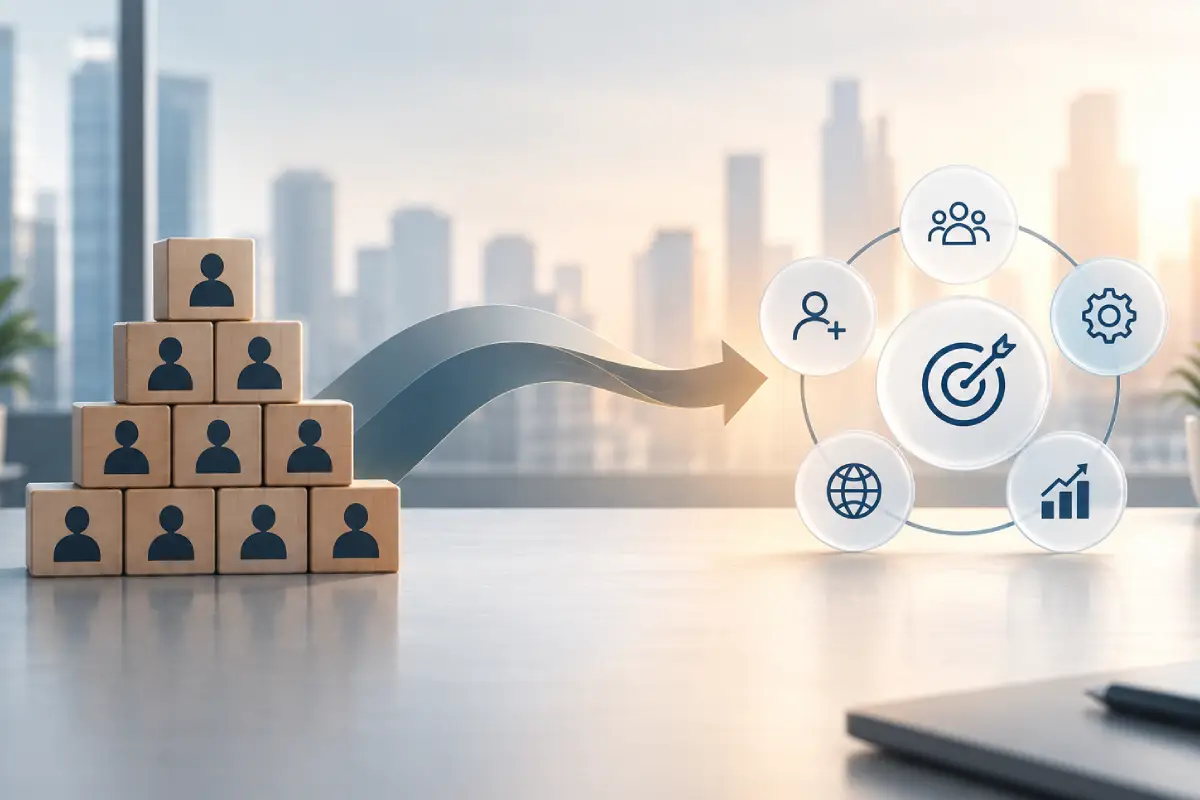
An Enterprise Digital Twin,a digital model of an organisation’s processes, systems and workflows,is one of the more genuinely useful applications of AI-era operations. It’s also one of the more commonly mis-scoped, usually because organisations either try to build it entirely in-house from a standing start, or hand it to a vendor and end up dependent on that vendor to run it indefinitely.
Enterprise digital twin vs. DigitalMe℠
Worth separating clearly, since the two get conflated often: an Enterprise Digital Twin models the organisation’s operations and belongs to the organisation. DigitalMe℠, our human digital twin, models an individual’s capability and belongs to that individual. One is a business asset; the other is a personal one. Both matter, but they solve different problems, for different owners.
What actually goes into building an Enterprise Digital Twin
A credible Enterprise Digital Twin isn’t a single model,it’s a layered representation built from several distinct inputs: process documentation and workflow logs that capture how work actually happens (not just how it’s documented as happening), system and data architecture that shows how information actually flows between platforms, and the decision points where human judgement currently governs an outcome, so the twin can represent where automation could apply and where it deliberately shouldn’t yet.
Getting the governance model right at this stage,who can query the twin, what it’s used to model, how its accuracy gets validated over time,matters as much as the technical build itself. A twin nobody trusts because its governance is unclear is functionally useless regardless of how accurate its underlying model is; adoption depends as much on confidence in the process as on the technology.
Build–Operate–Transfer for the Enterprise Digital Twin
For the Enterprise Digital Twin specifically, we use a Build–Operate–Transfer structure.
Build
We construct the twin against your actual process and systems data,not a generic template,mapping workflows, data architecture and decision points as they genuinely operate, including the gaps and workarounds that formal documentation usually misses. This phase typically surfaces discrepancies between how a process is documented and how it’s actually performed, which is itself useful information independent of the twin’s later use.
Operate
We run the twin under our AI Managed Services Provider model while it’s proven against live operations: validating its outputs against real outcomes, refining where it’s inaccurate, and expanding its scope as confidence builds. This is the phase where the twin earns trust,by being tested against decisions and outcomes the organisation can independently verify, not by being declared accurate at build completion.
Transfer
We hand over full ownership and control once the twin is mature,on a transfer point agreed up front, not left open-ended or dependent on continued vendor involvement by default. The client organisation takes on the twin’s ongoing operation and validation from that point, with the infrastructure and governance built during the Operate phase designed for exactly that handover.
Why transfer matters
A twin you don’t ultimately own is a dependency, not an asset. BOT exists specifically so the Enterprise Digital Twin ends up in your hands, running on your infrastructure, under your control,with Allied’s role being to get it there faster and with less build risk than doing it alone, not to remain the permanent operator of something that should belong to you.
What good looks like: signs the twin is actually working
A handful of signals distinguish an Enterprise Digital Twin that’s genuinely earning its keep from one that’s technically complete but operationally unused. It’s consulted routinely for real decisions, not just demonstrated in quarterly reviews. Its outputs get validated against actual outcomes on a defined cycle, with discrepancies investigated rather than ignored. The people who’d need to trust it,process owners, not just the technical team that built it,actually use it. And its scope has expanded since the initial build, which suggests it’s proving useful enough to extend rather than sitting static at its original boundaries.
Co-sourcing: the alternative to a full transfer
Not every organisation wants a complete handover, and that’s a legitimate choice rather than a fallback. Co-sourcing keeps delivery genuinely shared: your team and ours both operate the twin, with clearly defined responsibilities on each side, rather than a full transfer severing the relationship. It suits organisations that want the twin’s capability without building the internal team to run it entirely independently. The decision to co-source versus fully transfer is one you make deliberately, not a default we impose.
Common mistakes organisations make when building a digital twin
A few patterns account for most failed or stalled Enterprise Digital Twin projects. Building against documented process rather than actual process, the twin ends up modelling how work is supposed to happen, not how it does, which undermines its usefulness immediately. Skipping the operate phase and moving straight from build to transfer, an unvalidated twin handed over untested tends to erode trust fast once its outputs don’t match reality.
Treating the twin as a one-time build rather than something that needs ongoing validation as the underlying processes and systems continue to change. And under-investing in governance relative to the technical build, which produces a twin that’s accurate but that nobody with decision-making authority actually trusts enough to use.
Conclusion
Want to see what a Build–Operate–Transfer roadmap would look like for your organisation? Get in touch.
Frequently Asked Questions (FAQ)
How long does the operate phase typically last before transfer?
Long enough to validate the twin’s accuracy against live outcomes across a representative range of scenarios,the timeline is set by demonstrated reliability, not a fixed calendar date.
Can we start with co-sourcing and move to a full transfer later?
Yes,the two aren’t mutually exclusive end states; many engagements start with shared delivery and move toward fuller ownership as internal capability and confidence build.
Does an Enterprise Digital Twin require replacing our existing systems?
No, the twin is built to model your existing systems and processes as they are, not to replace them. It’s a representation layer, not a system migration.
Who within our organisation needs to be involved in the build phase?
Process owners and system architects are essential, since the twin is only as accurate as the input from people who genuinely understand how work happens day to day,not just those who wrote the original documentation.