
Key takeaways
- AI washing is exaggerating or misrepresenting how much a product or service actually uses AI. Regulators in the US have already taken action over it.
- In IT services, AI washing usually looks like the same delivery model with a chatbot or dashboard added. The test is whether the work itself has changed.
- Eight questions, starting with “what percentage of tickets resolve with no human involvement?”, separate a genuine AI Managed Services Provider from an MSP using AI.
Every IT services provider now says it uses AI. Proposals mention it on the first page, websites lead with it, and sales decks are full of it. For buyers, that creates a real problem: when everyone claims AI, how do you tell who has actually changed how they deliver, and who has just changed how they describe it?
That gap has a name: AI washing. This guide explains what it is, why it matters, what it looks like when you’re buying IT services, and the questions that cut through it.
What is AI washing?
AI washing is when a company exaggerates or misrepresents its use of artificial intelligence to make a product, service or business look more advanced than it is. The term mirrors “greenwashing”: the claim is bigger than the reality underneath it.
It ranges from vague language (“AI-powered” with no explanation of what the AI does) to claims that are simply untrue.
Why AI washing matters now
This isn’t just a marketing irritation. In March 2024, the US Securities and Exchange Commission charged two investment advisers with making false and misleading statements about their use of AI. Later that year, the US Federal Trade Commission launched Operation AI Comply, a crackdown on deceptive AI claims.
For buyers of IT services, the risk is quieter but just as real: paying an “AI premium” for a service that runs exactly as it did before, and building plans around efficiency gains that never arrive.
What AI washing looks like in IT services
In managed IT services, AI washing rarely involves outright false statements. It usually looks like this:
- A chatbot on the front, the same team behind it. Tickets get logged by a bot, then sit in the same queue for the same people to work through.
- Automation only where it was already easy. The simplest requests are automated; the bulk of the workload is untouched.
- Headcount that never moves. Whatever happens to ticket volume, the team on your account stays the same size.
- Savings that never reach you. Any efficiency becomes the provider’s margin, because the pricing model hasn’t changed.
- Reporting on activity, not resolution. Dashboards show tickets touched and response times, but never the share of tickets resolved with no human involvement.
An AI Managed Services Provider vs an MSP using AI
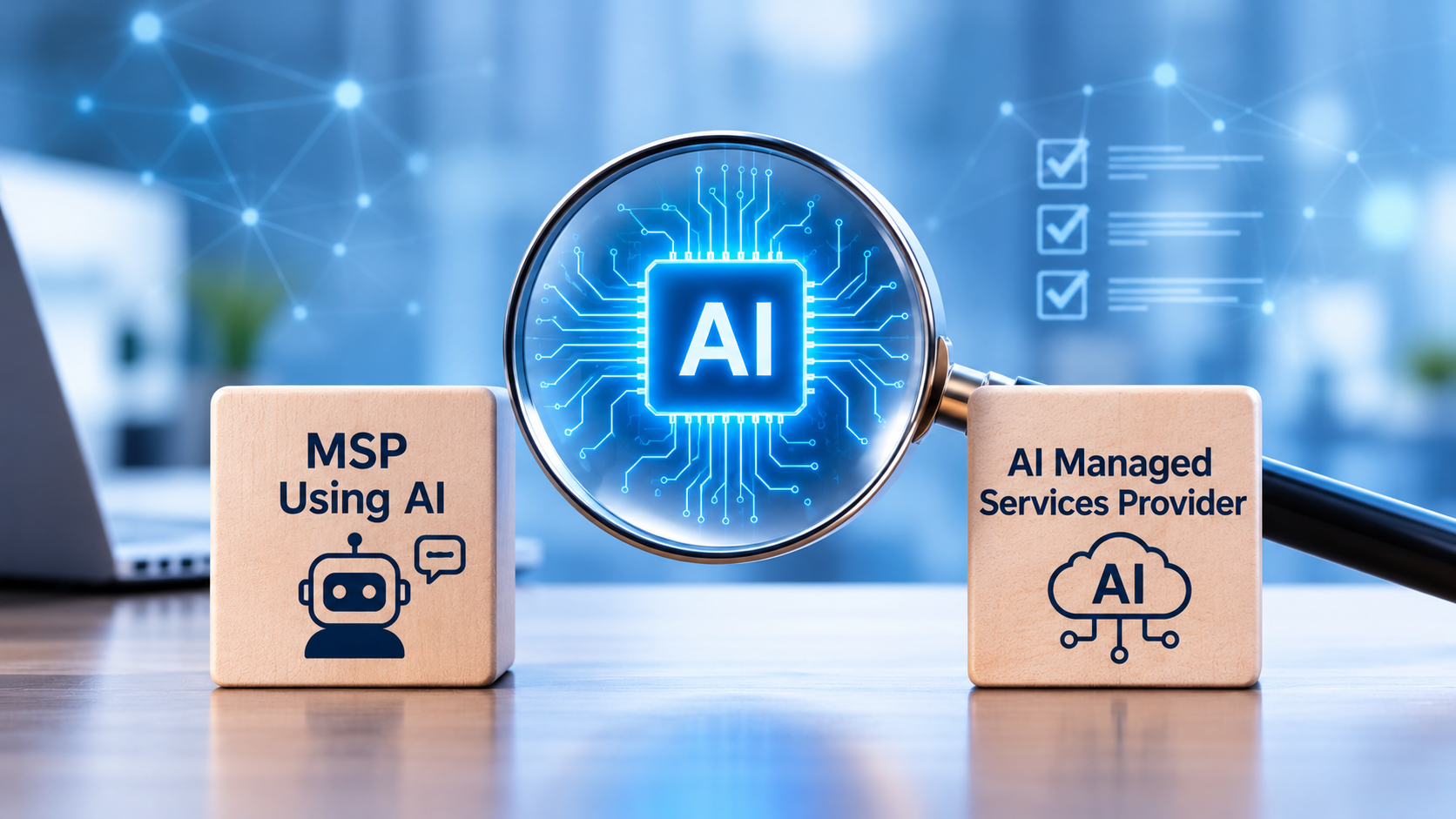
The difference isn’t whether a provider uses AI. It’s whether AI changed the operating model. An AI Managed Services Provider designs the split between human and digital work from day one. An MSP using AI adds tools to a delivery model built around people working tickets.
| MSP using AI | AI Managed Services Provider | |
| Where AI sits | Bolted onto an existing model | Built into how work is delivered |
| Routine tickets | Routed faster to a person | Resolved end to end by digital workers |
| Team size | Fixed, sized to peak demand | Sized to the complex work only |
| Pricing | Unchanged: per user, per device | Reflects the efficiency, often outcome-based |
| Key metric reported | Tickets handled, response time | Share of tickets resolved with no human involvement |
| What happens to people | Unclear | A clear, written commitment |
Eight questions that expose AI washing
Ask these in any IT services evaluation. A genuine AI-native provider will answer with specifics. AI washing tends to answer with adjectives.
- What percentage of tickets resolve with no human involvement? Ask whether it’s measured on live tickets or estimated.
- Can you show a current figure, not a case study? A number from three years ago says little about today.
- Was the automation designed against our ticket history? Or applied as a generic template?
- What does the AI actually do, step by step? If the answer stays at “it uses machine learning”, keep asking.
- What happens when the AI isn’t sure? Good systems escalate to a person. Poor ones guess.
- How does automation change what we pay? If the price doesn’t move, ask where the efficiency goes.
- How will the team on our account change over time? A fixed headcount regardless of volume is a warning sign.
- What happens to the people whose work gets automated? A verbal assurance isn’t the same as a contractual commitment.
What genuine AI-native delivery looks like
A provider that has actually changed its model will be comfortable being measured on a small set of hard numbers: the auto-resolution rate, resolution time by ticket category, how often escalations genuinely needed a person, and whether automated fixes stick. They’ll also be able to explain how those numbers connect to your invoice.
If you want to see what this looks like in practice, our guide to service desk automation walks through how auto-resolution works, ticket by ticket.
How Allied answers these questions
Allied is an AI Managed Services Provider, not an MSP using AI. Our FusionWork™ model designs the human and digital split from day one, and digital workers in our service desk operations resolve 84%+ of incidents with no human involvement (Allied’s stated figure).
- Pricing reflects the efficiency. Under our Flexible Resource Architecture (FRA™), cost follows demand rather than peak headcount. See how that compares in our guide to managed IT services pricing.
- People are protected in writing. Our DHRA™ (Digital Human Resource Architecture) carries a no-layoffs commitment: digital workers augment people, they don’t replace them.
- The philosophy is explicit. Original Augmented Intelligence (OAI), the founding principle of Allied founder Richard Skellett, holds that technology exists to augment human capability, not replace it.
Conclusion
AI washing thrives on vague language. The cure is specific questions. Ask what share of work is resolved without a person, how that’s measured, how it changes your bill, and what happens to the people. A provider that has genuinely changed its model will welcome those questions. One that hasn’t will change the subject.
Want to put these eight questions to us? Talk to our team and we’ll answer each one with live figures.
Frequently asked questions
What is AI washing?
AI washing is exaggerating or misrepresenting how much a product, service or business uses artificial intelligence, to make it look more advanced than it is.
Is AI washing illegal?
It can be. In the US, the SEC and FTC have both taken enforcement action over misleading AI claims. Rules vary by country and sector, so the legal position depends on the claim and where it’s made.
How do I know if an IT provider is really using AI?
Ask for the share of tickets resolved with no human involvement, measured on live data, and ask how that efficiency shows up in your price. Vague answers to either are a warning sign.
What is an AI-native company?
An AI-native company is built around what AI can do, rather than adding AI to a process designed for people. In IT services, that means the split between human and digital work is designed in from the start.
Is an AI Managed Services Provider more expensive?
Usually the reverse once running at scale, because digital workers absorb routine volume. Allied clients running FusionWork™ with FRA™ typically see a 30–40% cost reduction against a comparable fixed-headcount contract (Allied’s stated figure).