

Key takeaways
- FusionWork™ engineers which work goes to a digital worker and which goes to a human specialist,before automation is built, not after.
- The 84%+ first-touch resolution rate in Allied’s EMEA service desk operations is a consequence of that design choice, not a marketing figure layered on afterward.
- The Digital Human Rights Agreement (DHRA™) makes the no-layoffs commitment behind FusionWork™ contractual, paired with a workforce transition plan for every category of work that shifts to automation.
“Human + AI collaboration” has become one of those phrases that sounds precise and means almost nothing,it covers everything from a chatbot widget to a genuinely re-engineered operating model. We want to be specific about what we mean by it, because the difference matters to how work actually gets delivered.
What is FusionWork?
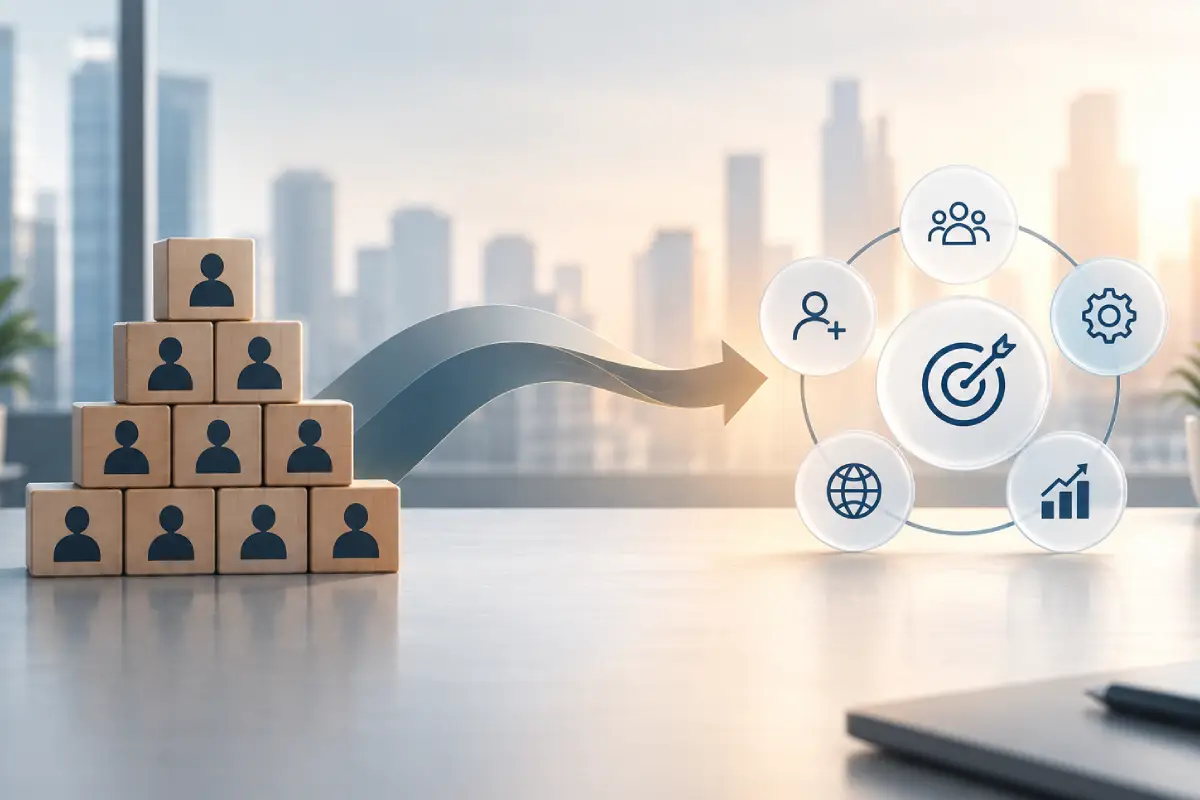
FusionWork™ is Allied’s delivery model, in which human specialists and digital workers are assigned roles by design, based on what each does best, rather than digital tools being layered on top of an unchanged human workflow.
Digital workers take on pattern-based, high-volume, rules-governed work: standard provisioning, known-error resolution, first-line triage, routine monitoring. Human specialists take on everything that needs context, judgement or a relationship: complex diagnosis, exception handling, stakeholder conversations, continuous improvement. Each does the work it’s actually suited to.
How the split gets engineered
The methodology behind FusionWork™ starts with a full workload audit, not an assumption. Every ticket type, request category and process step gets classified against a simple test: is this pattern-based enough for a digital worker to own with a defined confidence threshold, or does it require the kind of context and judgement only a human specialist can bring?
That classification then drives the workflow design: where a digital worker resolves outright, where it screens and a human closes, and where a ticket goes straight to a human. Governance sits on top of all three – confidence thresholds are monitored continuously, and anything a digital worker isn’t confident about; it escalates rather than guessing.
The audit itself draws on months of historical ticket data, categorised not just by type but by resolution complexity. Two tickets with the same category label can require very different levels of judgement, so the classification accounts for that instead of treating a ticket type as one monolithic category.
Digital workers vs. human specialists: what each actually does
- Digital workers own password resets and access provisioning, known-error resolution against a documented fix, first-line triage and categorisation, routine monitoring and alerting, and standard status updates.
- Human specialists own multi-system or ambiguous incidents, anything touching a VIP user or regulated data, root-cause investigation for novel issues, stakeholder and vendor conversations, process redesign and continuous improvement.
The line between the two isn’t fixed forever,as digital workers handle more of a given ticket category reliably, that category can move further into automated ownership; as an environment changes, categories get re-audited rather than left on outdated assumptions. A category that starts in the “digital-worker-triaged, human-closed” tier can move to full digital-worker ownership once enough resolved examples build confidence in the pattern, and equally, a category can move the other way if the environment changes and the pattern stops holding reliably.
Why the 84%+ number is a design outcome, not a marketing number
Most “AI-powered” service desks add automation where it’s easiest to bolt on, then measure success by how many tickets the bot deflects. FusionWork™ starts from the other direction: map the full workload, decide deliberately what belongs to a digital worker and what belongs to a person, then build the workflow around that split.
The 84%+ first-touch resolution rate we see in our EMEA service desk operations is a consequence of that design choice, not a marketing number bolted on afterward; it’s what happens when the classification work is done properly before the automation is built, rather than after.
Where the fusion changes commercial terms, not just delivery
FusionWork™ isn’t purely an operational change,it’s the mechanism that makes Allied’s Flexible Resource Architecture (FRA™) and outcome-based pricing possible at all. A fixed-headcount contract has to size the human team to peak ticket volume, because there’s no other layer absorbing the routine load.
Once digital workers reliably own the majority of that routine volume, the human team required shrinks to match the genuinely judgement-heavy remainder,which is the direct reason clients running FusionWork™ alongside FRA™ see 30–40% cost reduction against a comparable fixed-headcount model. The delivery change and the commercial change aren’t two separate initiatives; one enables the other.
FusionWork™ and the Digital Human Rights Agreement (DHRA™)
It isn’t a headcount reduction strategy dressed up in different language. Our Digital Human Rights Agreement (DHRA™) makes that a contractual commitment, not a talking point: when digital workers absorb routine load, the people who used to carry it move up into judgement and improvement work,they don’t get made redundant by the model that was supposed to support them.
In practice, that means the workload audit that defines the digital-worker/human split is paired with a workforce transition plan for every category of work that shifts to automation, agreed before the automation goes live, not retrofitted after the fact.
How FusionWork™ differs from RPA and legacy automation
Traditional robotic process automation scripts a fixed sequence of steps and breaks when the underlying process changes,a new field on a form, a system update, an edge case nobody scripted for. FusionWork™’s digital workers operate against a classification with a defined confidence threshold rather than a rigid script: when something falls outside the pattern they’re confident handling, they escalate to a human rather than failing silently or applying the wrong fix.
The classification itself is reviewed on a cycle, so it adapts as the environment changes instead of requiring a separate re-scripting project every time something shifts.
What FusionWork™ looks like in a typical service desk week
Picture a mid-sized enterprise service desk running FusionWork™. Across a typical week, tickets split into three categories:
- Routine volume: password resets, standard access requests, and known-error fixes; resolved by digital workers within minutes, with no queue time and no human touch.
- Ambiguous or multi-system tickets get sorted by a digital worker, pre-populated with relevant context, and handed to a human specialist who starts from an informed position rather than a blank ticket.
- Complex or sensitive issues route straight to a specialist from the first message.
The specialists on that desk spend their week almost entirely on the second and third categories, not because the first has disappeared, but because it no longer needs them. Over a typical month, that shift shows up two ways: fewer specialists are needed for steady-state volume, and more of their time goes to the process-improvement work that reduces ticket volume structurally, rather than just resolving it faster.
Measuring FusionWork™: what good looks like
A FusionWork™ deployment should be measurable against the same core figures regardless of client or industry: first-touch resolution rate with zero human touch, escalation accuracy (how often an escalated ticket genuinely needed a human, versus being a near-miss that should have been caught automatically).
Category coverage (what proportion of total ticket volume has been classified and assigned, versus still defaulting to human ownership by exception), and workforce transition tracking against the DHRA™ commitment for any category that moves to automated ownership.
Conclusion
That’s the core idea behind an AI Managed Services Provider, in practice: not AI replacing people, and not people ignoring AI, but a delivery model engineered around what each does best.
Want to see how FusionWork™ would map against your current service desk workload? Talk to our team.
Frequently Asked Questions (FAQ)
Does FusionWork™ require us to change our existing ticketing system?
No, FusionWork™’s digital workers integrate with the ticketing and ITSM tools already in place; the classification and workflow design sit on top of your existing systems rather than requiring a platform migration.
What happens when a digital worker gets something wrong?
Confidence thresholds are set deliberately conservatively, and anything outside a digital worker’s defined pattern escalates to a human rather than being resolved incorrectly. Error patterns feed back into the classification review cycle.
Is FusionWork™ only applicable to IT service desks?
The model applies wherever there’s enough volume and pattern consistency to classify reliably,it’s used in IT service desk operations most visibly, but the same human/digital split methodology applies to other high-volume operational functions.
How is FusionWork™ different from a generic “AI copilot” added to an existing helpdesk?
A copilot assists a human working through every ticket. FusionWork™ removes entire categories of ticket from the human queue altogether, based on a deliberate classification,the difference between augmenting every interaction and eliminating the need for a human interaction in the majority of cases.